
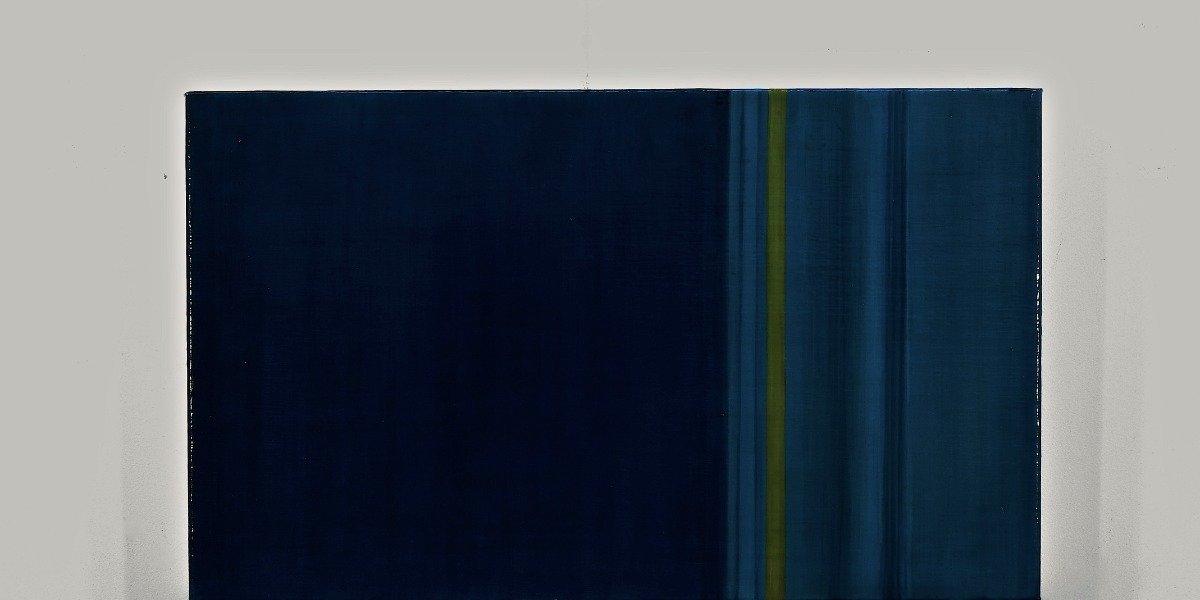
Overlap – An Ode to empathy
Húbert Nói Jóhannesson - Listasafn Samúels 2026
Húbert Nói Jóhannesson focuses on the interaction of internal and external reality in his works where memory and locations play a central role in mapping spiritual realm in coexistance with external realm and an attempt to synchronize the two realities.
Memory being still a mystery is of concern and whether it, along with consciousness, is located solely within a person or if it partially overlaps and is connected to other individuals or biomes, that is whether consciousness is collective. If this is the case, the idea of the all-seeing eye of God is relevant because everything you do and your eyes see, all good deeds and misdeeds, is recorded in this shared consciousness.
The advent of the internet and the process of artificial intelligence reflects this, as systems created by humans always mimic processes that already exist in nature. Everything you do on your computer is recorded on the internet, and everything you do to others, good or bad, is likewise recorded in the collective consciousness.
Human consciousness floats on top of the deep knowledge of evolution, experience and inheritance, this immense wisdom of nature is our Mímisbrunnur (well of knowledge in Norse mythology) active system that one individual can never fully understand.
Everything you do on your computer is recorded to the Internet. Everything you do to others, good or bad, is recorded in the same way in the collective memory. If one consciously goes against life through lies, killing, or aggression, one's good days are counted down.
A basic principle in biological processes is the conservation of energy, and behavior that wastes energy and disrupts progress is outsourced from the system of collective consciousness, and the doer thereby loses his purpose. Ice ages and meteorites could not stifle the spirit of life, and war could not stifle the human spirit, two spirit realms which are intertwined. It is a reality that a greedy and war-crime-ridden world needs to be aware of, because good always triumphs over evil.
Overlap.
For me, receiving an invitation to exhibit at the Samúel Jónsson Museum in Selárdalur is almost like receiving an invitation to enter Jón Árnason's folklore. I have never been to Selárdalur and seen the artworks and buildings, but in my spiritual dwellings, Samúel's works have had a place ever since they appeared to me, along with a church in a remote valley and the story of how the works were made. Ever since, this place has had an aura of a legendary adventure for me.
I intend to bring with me for this exhibition three other artists whose works exist in my spiritual realms and in an effort to share worldly experiences I have painted works originated from their homes. The works are surfaces in architecture that I know they confronted and by that held within themselves.
The works are from Drottninggatan 85. Stockholm - the Blue Tower - where August Strindberg* lived in the last years of his life. There are also works from the home surroundings of Wilhelm Hammershøi* Strandgade 30. in Copenhagen and from Hauptstrasse 155. David Bowie's home in Berlin where he made his trilogy in the 1970s at the geopolitical contact point of the Cold War. As well is a painting from my former home at Neshagi 4. Reykjavík.
These geometric works are double geometry i.e. both formally and spatial - Geometria intra Geometria - and here in the Samúel Jónsson Museum they, along with the characters associated with them, form an overlap or set of formats that varies depending on the extent of the work and genesis of these separate artists are to each visitor to the exhibition.
*I knew August Strindberg as a writer and playwright, but he appeared to me as a painter during my school years of 1984-5 when my teacher showed me paintings by Strindberg that had the same color palette and the same subject matter as the works I was working on at the time. This connected me to Strindberg as well as an interest in alchemy, which we both examined separately, and not least because he was a friend of Edvard Munch, the greatest painter of the 20th century.
*Wilhelm Hammershøi came into my life in 1990 when the, then art critic for Morgunblaðið, Bragi Ágeirsson compared my works at an exhibition to Hammershøi's works and vision.
I was young and ambitious at the time and became irritated by these writings since I was not familiar with Hammershøi's work and did not know whether he was my contemporary or anything. This was before the internet and Hammershøi was little known outside of Denmark, which changed with the exhibitions in The United States. Books and writings about Hammershøi were published, which I became familiar with, and then I understood what Bragi Ásgeirsson meant by the metaphor, which turned out to be one of the greatest compliment I have ever received.
Húbert Nói Jóhannesson graduated from the Experimental Department at the Icelandic School of Art and Crafts in 1987 and has held over forty solo exhibitions and participated in over sixty group exhibitions.
Works by Húbert Nói Jóhannesson can be found in all major museums in Iceland, as well as numerous private collections in Iceland and abroad.